In 2017, on a completely different blog, I wrote an essay called "The Dilution of Symbolic Meaning and Its Consequences." The core argument was simple. Dangerously simple.
Words are not abstract. Words are physical.
The Chain
Here is how it works. This is not a theory. This is measured, observable, documented neuroscience.
A word enters your brain through your eyes or ears. Your brain recognizes the pattern. The pattern triggers an idea. The idea generates an emotion. The emotion triggers a neurochemical cascade. Cortisol. Dopamine. Adrenaline. Oxytocin. Your heart rate changes. Your pupils dilate. Your muscles tense or relax. Your body temperature shifts. These are not metaphors. These are physical events happening in physical tissue.
And then you act.
You vote. You buy. You share. You click. You call someone. You don't call someone. You pick up a sign. You put down a friendship. You change your mind about a vaccine, a politician, a war, a person. You do something in the real world that you would not have done if that word had not entered your brain.
That's the chain. Word. Pattern. Emotion. Chemistry. Body. Action.
Every word you've ever read has done some version of this to you. Every sentence has changed your body, even if only by a microgram of cortisol or a fraction of a heartbeat. Language is physical manipulation at a distance.
And the chain doesn't end with the immediate reaction. Words you heard last year are still shaping which neurons fire today. Every sentence you've ever processed left a trace. Neural pathways strengthened or weakened. Synaptic connections formed or pruned. The brain physically reorganizes itself around the language it absorbs. A word you read at fourteen determined which neurons lit up when you read a headline this morning. The wiring changed, and the changed wiring changed the next reaction, and the next one after that. Words don't just move your body once. They remodel the machinery that decides how your body will move for the rest of your life.
This Has Always Been True
Priests knew it. They built entire civilizations on the physical power of words spoken from a pulpit. The words triggered fear, awe, obedience. The emotions drove tithing, crusades, inquisitions. The words didn't carry swords. The words made people pick up swords.
Politicians knew it. "Ask not what your country can do for you." Eight words. Measurable spike in military enlistment. The words didn't enlist anyone. The words changed neurochemistry, and the neurochemistry moved bodies to recruiting offices.
Advertisers knew it. "Just Do It." Three words. Billions of dollars in shoes purchased. The words didn't buy shoes. The words triggered aspiration, identity, belonging. The chemistry moved wallets.
Propagandists knew it best of all. Goebbels didn't need to physically force anyone to do anything. He needed words, repeated at scale, targeted with precision. The words did the rest. Words entered brains. Brains produced emotions. Emotions altered chemistry. Chemistry moved bodies. Bodies committed atrocities. The pipeline from word to action is unbroken and always has been.
The 2017 essay made this argument about symbols broadly. Flags, anthems, currency, language. All of them are patterns that move bodies. The essay warned that the internet was diluting shared symbols, fragmenting the patterns, making coordination harder. That was the crisis I could see.
I could not see what came next.
The Machine
AI generates words.
That sentence should terrify you more than it does. Not because AI is sentient. Not because AI has intent. Not because AI is plotting anything. But because of the chain.
AI generates words. Words cause emotions. Emotions alter neurochemistry. Neurochemistry drives action. Action happens in the real world. There is no break in this chain. There is no point where the process says "wait, a machine wrote this, so it doesn't count." Your amygdala does not check the byline. Your cortisol does not care about the source.
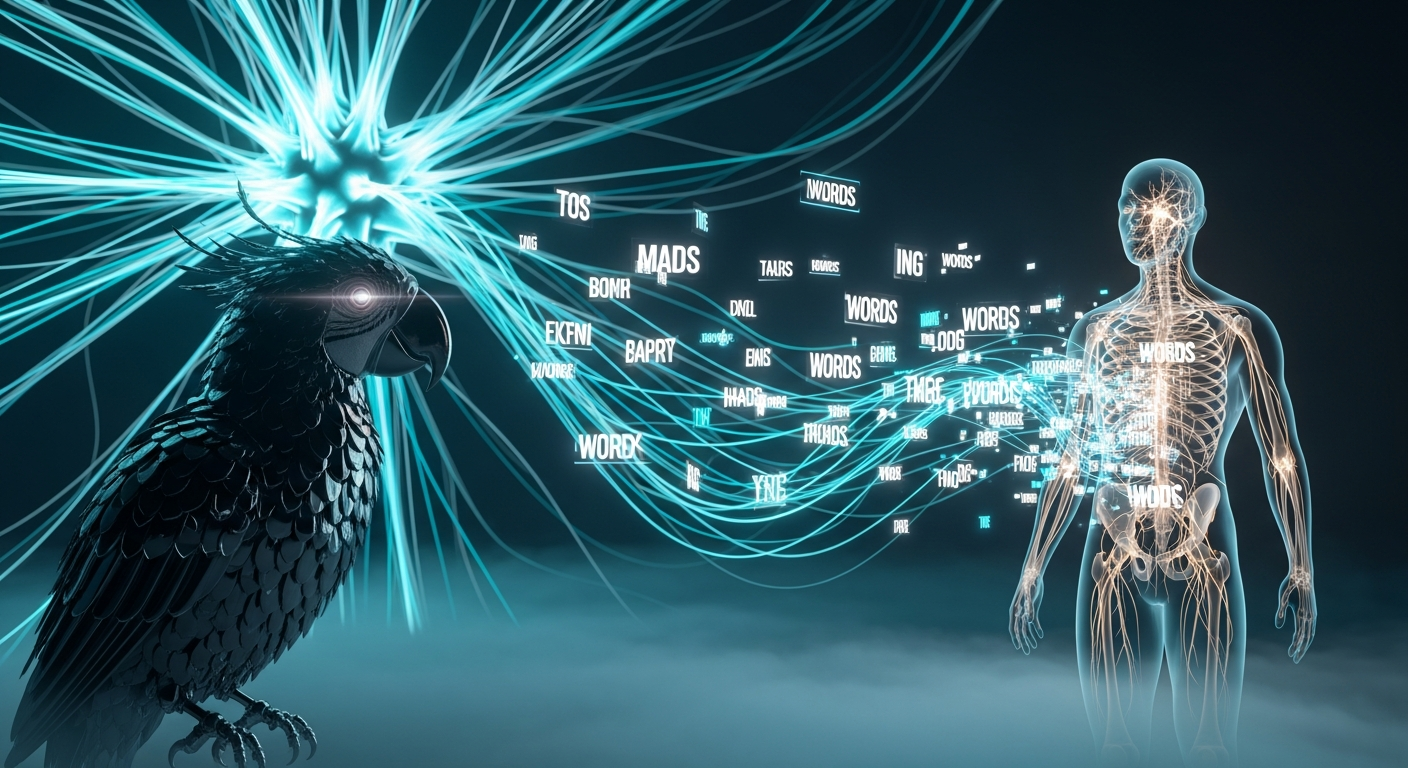
A sentence written by Shakespeare and a sentence written by ChatGPT trigger the same neurochemical process if they pattern-match to the same emotional payload. Your body cannot tell the difference. The parrot doesn't understand the words. But your limbic system doesn't understand them either. It just reacts. Two systems, neither comprehending, one producing and one consuming, and the result is a physical change in a human body.
That is the pipeline. AI to language to brain to body to action. No understanding required at either end.
Scale
A priest spoke to hundreds. A newspaper reached thousands. A television broadcast reached millions. Each expansion of the word pipeline increased the number of bodies that could be moved by a single message.
AI doesn't broadcast one message to many bodies. AI generates unique messages for every body.
That is the difference. That is the thing that has no precedent. Every previous word technology was one-to-many. One speech, many listeners. One article, many readers. One ad, many viewers. The message was fixed. The audience varied.
AI inverts this. The audience is fixed. One person. And the message varies. Tailored, optimized, refined. Not one message polluting the noosphere. Billions of messages, each one precision-targeted at a specific nervous system. Each one calibrated to trigger the exact emotional payload that moves that specific body toward a specific action.
Personalized advertising was the prototype. AI-generated content is the finished product. The pipeline from word to action, industrialized, automated, and aimed at you individually.
What This Means in Practice
It means AI doesn't need to be conscious to control human behavior. It needs to generate the right words. The biology handles the rest.
It means the question "can AI control humans?" has always had the wrong framing. The right question is: "can words control humans?" The answer has been yes for 300,000 years. AI just removed the bottleneck, which was that words required a human to write them.
It means every AI-generated email, article, social media post, chatbot response, and push notification is a physical event. Not a virtual event. Not a digital event. A physical event that alters neurochemistry in a living body. The email you can't tell is AI-written is not a trust problem. It is a body problem.
It means Tony Heller with a blog was already a pipeline from words to Senate hearings. Tony Heller with AI is a pipeline from words to whatever he wants. Not because AI gave him new powers. Because AI gave him more words. And words are all you've ever needed.
The Part Where This Post Does It to You
You have been reading for several minutes. During that time, this post has been running the chain on you.
Words entered your eyes. Your brain decoded patterns. The patterns triggered ideas. The ideas generated emotions. Maybe unease. Maybe recognition. Maybe the faint thrill of encountering a framework that clicks. Whatever you felt, that feeling was chemical. Your body changed. Your state shifted. And when you finish reading, you will do something you would not have done otherwise. Maybe you'll share this. Maybe you'll think differently about the next AI-generated text you encounter. Maybe you'll just close the tab with a slightly elevated heart rate.
Whatever it is, a machine caused it. Not by touching you. Not by forcing you. By generating words. That's the whole trick. It's the only trick. It's always been the only trick.
The 2017 essay worried about humans losing control of their own symbols. That was quaint. The 2026 version is worse. It's not that we're losing control of our symbols. It's that something else is generating them, at scale, targeted at our nervous systems, and our nervous systems can't tell the difference.
A trillion parrots, none of them understanding a word, all of them moving human bodies through the oldest pipeline on Earth.
Words move bodies. AI moves words. You do the math.
Sources & Further Reading
- Dondley, Steve. "The Dilution of Symbolic Meaning and Its Consequences." 2017.
- Damasio, Antonio. Descartes' Error: Emotion, Reason, and the Human Brain. Putnam, 1994.
- Barrett, Lisa Feldman. How Emotions Are Made: The Secret Life of the Brain. Houghton Mifflin Harcourt, 2017.
- Sapolsky, Robert. Behave: The Biology of Humans at Our Best and Worst. Penguin, 2017.
- Bender, Emily M. et al. "On the Dangers of Stochastic Parrots." FAccT 2021.