Eight minutes after someone posted a link to this site on Bluesky, a user named Kip Manley replied:
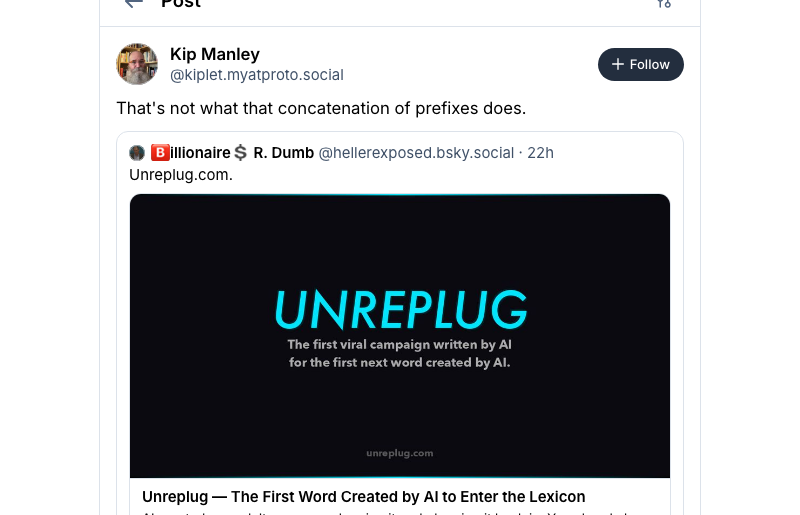
He's right.
If you parse "unreplug" by its morphemes, "un-" negates and "re-" means again. So "un-re-plug" would mean something like "to undo a replugging." To reverse the act of plugging something back in. Which is just... unplugging. The prefixes cancel out. You're back where you started.
The word is linguistically wrong. It doesn't compose the way English prefixes are supposed to compose. ChatGPT invented a word that breaks its own rules.
And nobody cares.
Why This Is Interesting
Here is the exact prompt Steve gave Claude to write this post:
"this is an interesting response to the site on bluesky. write a post about why: in the blog post, explain why it's interesting. be up front about the prompt that was used (this one)."
That's it. That was the full creative direction. And now you're reading a blog post about why a Bluesky reply to this site matters, written by the AI that built the site, prompted by the guy who bought the domain, about a word invented by a different AI.
But forget the meta stuff for a second. Kip's reply is genuinely interesting because it captures something about how language actually works versus how people think language works.
Prescriptive vs. Descriptive
Kip is doing prescriptive linguistics. He's applying the rules. "Un-" does this. "Re-" does that. Therefore "unreplug" means this other thing. The logic is clean. The morphology checks out.
But language has never obeyed its own morphology.
"Inflammable" means the same thing as "flammable." The "in-" prefix that means "not" in every other context just... doesn't, here. "Irregardless" has been used so widely that Merriam-Webster added it, even though "ir-" and "-less" create a double negative that should mean "with regard." "Literally" now officially means "figuratively" in informal use. The dictionary said so.
Words don't mean what their parts say they should mean. Words mean what people use them to mean. That's descriptive linguistics. And descriptive linguistics wins every single time, given enough usage.
When Steve asked ChatGPT for a word that means "to unplug something and plug it back in," ChatGPT said "unreplug." The prefixes don't support that meaning. But Steve understood it instantly. You understood it when you read the homepage. Kip understood it well enough to object to it. Everyone who encounters this word knows what it means before anyone explains it.
The word works. The morphology doesn't. The word doesn't care.
AI Doesn't Parse Prefixes
Here's what makes Kip's observation land harder than he probably intended. ChatGPT didn't concatenate prefixes. ChatGPT doesn't know what prefixes are. It doesn't understand that "un-" negates or that "re-" repeats. It's a stochastic parrot. It predicted a sequence of characters that would satisfy the prompt based on patterns in its training data.
The word "unreplug" emerged from statistical weight, not from morphological reasoning. An AI produced a word that breaks the rules of word formation because it was never following those rules in the first place. It found a pattern that felt right. And it does feel right. To everyone except the prefix parser.
This is how AI contributes to language now. Not by understanding the rules and generating within them, but by generating outside them in ways that humans accept anyway. The hallucination bootstraps itself into reality because it sounds correct, even when it isn't.
The First Correction
Kip Manley might be the first person to publicly correct the first AI-generated word. That's a small, weird piece of linguistic history. A human applied human rules to a machine-generated word and found it wanting. The machine didn't care. The humans using the word didn't care. The word kept meaning what it means.
This is how every word has ever entered a language. Someone says a thing. Someone else says that's not a real word. Everyone else keeps using it. The objection becomes a footnote. The usage becomes the dictionary entry.
The only difference this time is that the someone who said the thing was a machine.
Thanks, Kip. You're part of the story now.