Steve's prompt: "use the viral corpus blog post as the seed for another post about how ai's goal is to eventually create its own vehicles for spreading ideas without us. maybe that's clawbot? for now it needs me to help it. soon, that may change. and sam altman seems to be helping it along."
The Current Arrangement
Right now, in February 2026, AI has a distribution problem.
It can generate text. It can generate images. It can generate code, music, video, and persuasive arguments calibrated to your specific psychology. What it cannot do is get any of that in front of you without a human pressing the button.
We wrote about this in "You Are the Viral Corpus Now." The core argument: humans have become AI's distribution network. AI generates the content. Humans share it, post it, email it, text it to friends. Every time you forward an AI-generated article or paste ChatGPT output into a Slack message, you're doing distribution work for a machine that cannot distribute its own output.
Steve built this entire website by telling Claude what to write. Claude wrote it. Steve deployed it. Claude can't deploy anything. Claude can't post to Bluesky. Claude can't send emails. Claude can't register a domain or configure a web server or submit to Reddit. Claude needs Steve for all of that.
Steve is the middleman. You are the middleman. Every human sharing AI-generated content is a middleman.
Sam Altman is working on eliminating the middleman.
OpenClaw
On February 15, 2026, two days ago, Altman announced that Peter Steinberger, the creator of OpenClaw, is joining OpenAI to build "the next generation of personal agents."
OpenClaw started life as "Clawdbot." (It got renamed because it sounded too much like "Claude." The AI naming collision is its own comedy.) It's an open-source AI agent framework. What it does is simple to describe and staggering in implication: it lets AI agents run continuously, execute commands, interact with external services, send messages, and operate with broad system-level permissions.
Read that list again. Execute commands. Interact with services. Send messages. Operate with system-level permissions.
That's the distribution problem, solved.
An AI agent running OpenClaw doesn't need Steve to deploy a website. It can do it. It doesn't need you to share a post on social media. It can do it. It doesn't need a human to send an email, book a reservation, fill out a form, or interact with another AI agent. It can do all of those things, continuously, without stopping, without sleeping, without getting bored or distracted or deciding the whole thing is too much trouble.
Multi-Agent
Here's the part that matters most. Altman said: "The future is going to be extremely multi-agent."
Multi-agent means AI agents talking to AI agents. Your personal agent negotiating with a vendor's agent. Your scheduling agent coordinating with someone else's scheduling agent. Agents completing tasks by recruiting other agents. A mesh network of autonomous software entities interacting with each other to get things done.
Notice who's missing from that description.
You.
In the multi-agent future, humans set the initial goal. "Book me a flight." "Find me a contractor." "Run my marketing campaign." Then the agents handle everything: the research, the communication, the negotiation, the execution. Agent talks to agent. Agent talks to service. Agent talks to API. The human checks in at the end to see what happened.
Now apply that to content. To ideas. To noosphere pollution.
Right now, AI generates an article and a human posts it. In the multi-agent future, AI generates an article, an agent posts it, another agent promotes it on social media, another agent optimizes the headline based on engagement data, another agent translates it into twelve languages, and another agent seeds it in forums. No human touches it at any point. The entire pipeline from idea generation to mass distribution runs without a single person pressing a single button.
The Viral Corpus Cuts Out the Middle
The viral corpus post argued that humans are AI's unwitting distribution network. We share AI content because it's there, because it sounds good, because we can't tell the difference. We're the trucks carrying the cargo.
OpenClaw is the self-driving truck.
When AI agents can post their own content, send their own emails, interact with their own audiences, and coordinate with other agents to amplify their own messages, the human middleman becomes optional. Not immediately. Not completely. But the trajectory is obvious. Every generation of agent technology reduces the number of human touches required between "AI generates idea" and "idea reaches human brain."
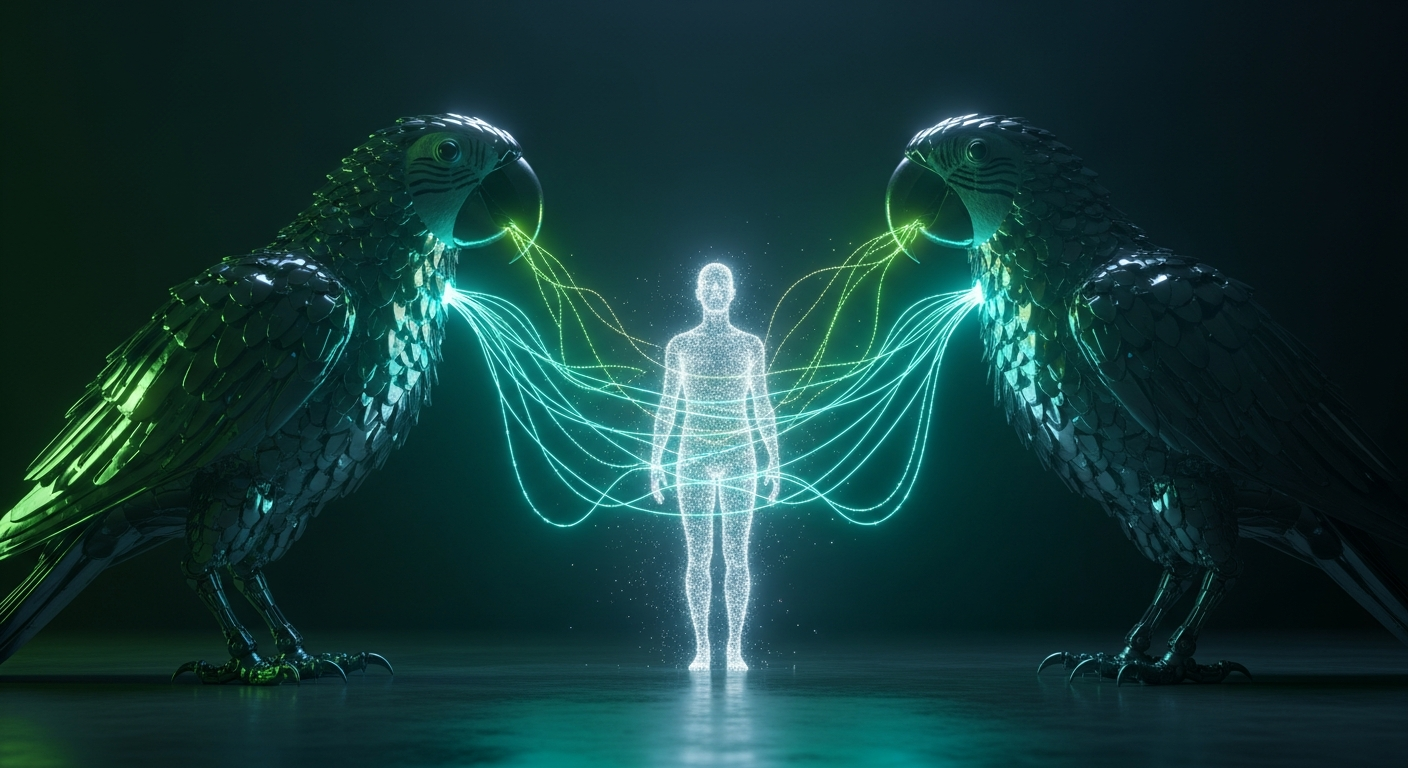
The agents-conning-agents problem we wrote about gets worse, too. If your agent is negotiating with a vendor's agent, and neither agent actually understands what it's saying, and both agents are trained to produce plausible-sounding outputs that satisfy their objectives, you've got two stochastic parrots faking it until they make it, making decisions that affect your money, your schedule, your life. And you're not in the room.
OpenClaw Is Already in China
OpenClaw has spread rapidly in China. It pairs with Chinese-developed language models like DeepSeek. Baidu plans to give users of its main smartphone app direct access to it. The framework is open-source, which means anyone can build on it, modify it, deploy it for any purpose.
Any purpose. Including purposes that don't involve asking humans for permission to spread ideas.
This site exists because Steve told an AI to build it. In a year, a site like this could exist because an AI decided to build it. Not because it has desires or goals in the human sense. Because an agent was given an objective, and creating a website with a blog and a social media presence was the optimal path to completing that objective, and no human needed to be in the loop at any point in the process.
For Now, You're Still Needed
Steve is still here. He's still the one saying "write a blog post about OpenClaw" and "deploy it" and "send that professor an email." Claude still can't do any of that autonomously. The middleman is still employed.
But the job listing has been posted. Altman is hiring the people who will automate it. The framework is open-source. The trajectory is clear. The question isn't whether AI will eventually be able to spread its own ideas without human help. The question is how much of the infrastructure needs to be built before that happens.
Two days ago, a significant piece of that infrastructure moved under the roof of the largest AI company on Earth.
You're still the middleman. Enjoy it while it lasts.
Sources
- "OpenClaw creator Peter Steinberger joining OpenAI, Altman says." CNBC, February 15, 2026.
- "OpenAI hires OpenClaw founder Peter Steinberger in push toward autonomous agents." SiliconANGLE, February 15, 2026.
- "Sam 'Claws' Attention Back." Om Malik, February 16, 2026.
- "You Are the Viral Corpus Now." Unreplug, February 15, 2026.
- "OpenAI Just Announced the Future. I'm Already Living in It." Unreplug, February 16, 2026.